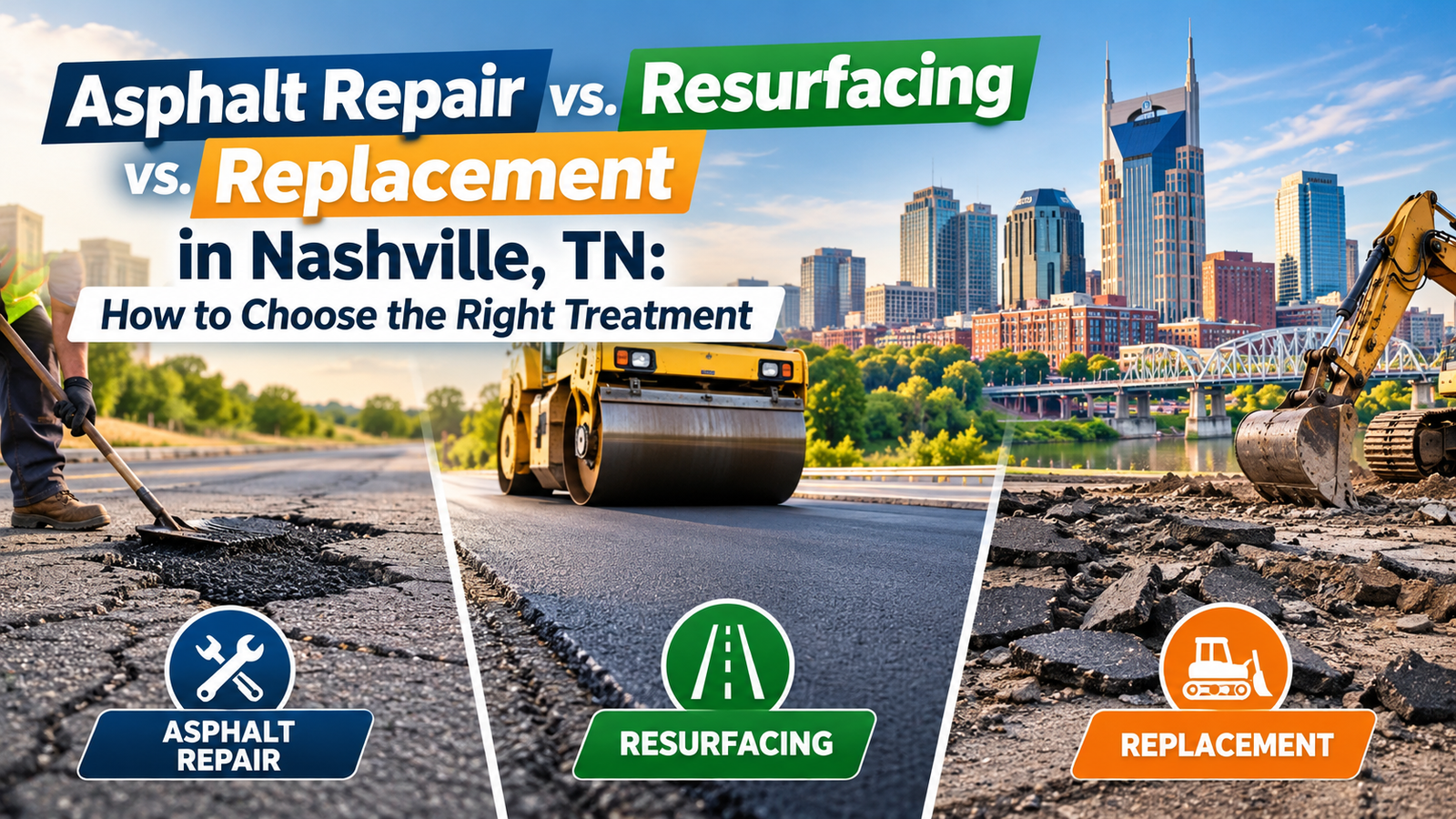
Nashville’s commercial and residential property owners face a common decision when asphalt pavement starts showing its age: is this a repair situation, a resurfacing situation, or does the pavement need to come out entirely? The answer matters because the three options represent very different investments, very different disruptions, and very different timelines of value. Choosing the wrong one replacing pavement that could have been resurfaced, or resurfacing pavement that actually needs replacement wastes resources on one end and produces a short-lived fix on the other.
This guide explains the technical logic behind the repair-resurface-replace decision in the context of Nashville’s climate and Middle Tennessee’s specific pavement challenges.
Understanding Pavement Condition: The Foundation of the Decision
Asphalt Repair Vs Resurfacing Vs Replacement Nashville Every repair-resurface-replace decision starts with a pavement condition assessment. The visible surface of the pavement tells an experienced evaluator a great deal about what is happening below. Different distress types have different implications for the structural health of the pavement, and reading those distress types correctly is the core skill of pavement assessment.
Surface cracking hairline to moderate-width cracks that run in irregular or block patterns indicates surface oxidation and binder hardening. The asphalt binder depletes over time through UV exposure and oxidation, causing the surface to become brittle and crack. This is surface-level deterioration: the base and subgrade may still be intact beneath the cracking surface. Surface cracking responds well to crack sealing as a maintenance treatment and to resurfacing as a rehabilitation treatment.
Alligator cracking sometimes called fatigue cracking is a very different signal. The interconnected, mesh-like crack pattern that resembles alligator skin indicates structural failure of the pavement base or subgrade. The pavement has been flexed repeatedly under traffic loads beyond its structural capacity typically because the base is too thin, the base has been weakened by water infiltration, or the subgrade has lost bearing capacity. Alligator cracking is a base failure indicator, not a surface problem. Resurfacing over alligator-cracked pavement will not fix the problem; the same cracking pattern will appear in the new overlay within months to a few years.
Rutting permanent deformation in the wheel paths of a parking lot or road can originate in the asphalt surface layer (asphalt mix rutting from high-temperature flow) or in the base/subgrade (structural rutting from base failure). Shallow rutting that follows only the tire path in the top layer of asphalt may be addressed by milling and resurfacing. Deep rutting that extends to the base or shows corresponding deflection of the base course requires structural repair before any surface treatment.
Potholes are localized structural failures, typically initiated by water infiltration through a crack, saturation of the base and subgrade, and the loss of support that follows. In Nashville’s climate heavy summer thunderstorms, moderate winter freeze-thaw cycling pothole formation is an active process. Individual potholes are repair items; widespread pothole development indicates a systemic base or drainage problem that points toward more extensive rehabilitation.
Asphalt Repair: The Right Choice for Localized Problems
Repair is the appropriate treatment for localized distress on an otherwise sound pavement. The key word is localized affecting a small percentage of the total pavement area, typically under 15 to 25 percent. When the majority of the pavement is in acceptable condition and only specific problem areas have failed, repair addresses those areas while preserving the surrounding sound pavement.
Full-depth patching removes the failed pavement down to or into the base course, addresses any base-level problem, and places new asphalt in the repaired area. For pothole repair and base failure areas in Nashville’s commercial parking lots, full-depth patching is the standard repair method. A properly executed full-depth patch sawcut edges, clean excavation, repaired base, tacked and filled with hot mix, compacted level can outlast the surrounding pavement if the underlying cause of the failure is corrected.
Infrared patching is a hot-in-place repair method where an infrared heater softens the existing asphalt, the area is scarified, new material is added if needed, and the area is regraded and compacted. Infrared patching integrates better with the surrounding pavement than a sawcut patch because the edges between new and existing material are heated and blended rather than cold-joined. In Nashville, where summer heat already softens asphalt, infrared patching is particularly effective when performed in the cooler shoulder seasons.
The limitation of repair-only approaches is that they are site-specific. A parking lot with 20 potholes and a dozen significant alligator-cracked areas spread across 30 percent of its surface area is approaching the threshold where individual repairs no longer make economic sense. The labor and material cost of addressing each problem individually approaches or exceeds the cost of a comprehensive resurfacing treatment.
Asphalt Resurfacing: The Middle Path
Resurfacing also called overlay or mill-and-overlay is the right treatment when the pavement surface has deteriorated but the base course and subgrade remain structurally sound. It delivers a new wearing surface across the entire area at once, eliminating all surface-level distresses and restoring a uniform, serviceable condition.
The critical precondition for resurfacing is base integrity. Before committing to resurfacing, an honest assessment must establish that the distress visible at the surface is surface-level not a reflection of base failure. This assessment can be made visually by an experienced evaluator, supplemented if necessary by coring the pavement to inspect the base and subgrade condition.
In Nashville’s commercial property context, the ideal resurfacing candidate is a parking lot or driveway that shows widespread surface cracking, significant oxidation (the gray, weathered color of aged asphalt), minor raveling, and perhaps some isolated patches but no widespread alligator cracking and no significant rutting. This pavement profile indicates a surface that has reached the end of its useful life as a wearing surface while its structural foundation remains intact.
Pre-resurfacing preparation in Nashville should address all localized structural failures before the overlay is placed. Alligator-cracked areas even small ones should be full-depth patched before the overlay to prevent reflective cracking. Drainage corrections that require grade work should be made during the milling phase. A resurfacing project that skips preparation to save time will see those preparation shortcuts manifest as early resurfacing failures.
Full Replacement: When There Is No Other Option
Full replacement removing the existing pavement structure down to the subgrade and rebuilding from the ground up is the appropriate treatment when structural failure is widespread, when the base has been compromised beyond repair, or when the pavement design was inadequate for the actual loading it has been receiving. It is the most disruptive and most expensive option, but it is also the only option that produces a full-life pavement on a site with failing structure.
In Nashville, full replacement is commonly triggered by three conditions. First, widespread alligator cracking affecting more than 40 to 50 percent of the pavement area indicates base failure so extensive that full-depth patching of individual areas is not practical. Second, significant rutting that extends into the base course indicates base deformation that will not be solved by surface treatment. Third, drainage failure the pavement structure is saturated because original drainage was inadequate and was never corrected requires access to the base and subgrade to install proper drainage before rebuilding.
The silver lining of full replacement is that it is an opportunity to correct everything: inadequate base thickness, inadequate drainage, improper subgrade preparation, or any other design shortfall in the original installation. A properly designed and built replacement pavement will significantly outlast the original, and it starts its service life with a full design life ahead of it rather than a remaining fraction.
The Financial Logic: Timing the Decision
The repair-resurface-replace decision has a financial dimension that matters. Pavement management research shows that the most economical time to resurface is before the pavement deteriorates into the zone where base failure has begun before alligator cracking has spread. Once base failure is widespread, the cost of the required patching and base work before resurfacing approaches or exceeds the cost of full replacement. The pavement that could have been resurfaced for modest investment at Year 12 may require full replacement by Year 18 if maintenance is deferred.
In Nashville’s commercial property context, this translates to a practical recommendation: track pavement condition on a schedule, resurface when the surface shows widespread oxidation and surface cracking but before base failure develops, and use repair to address localized problems between major rehabilitation cycles. This approach maximizes the value extracted from each dollar of pavement investment.
Frequently Asked Questions: Repair vs Resurfacing vs Replacement in Nashville
How do I know if my parking lot needs resurfacing or replacement?
The key diagnostic is the nature and extent of the cracking. Surface cracking irregular, block patterns with no significant rutting suggests a surface problem suited to resurfacing on a sound base. Alligator cracking the interconnected mesh pattern indicating base failure suggests structural failure that requires either extensive patching before resurfacing or full replacement if widespread. A qualified contractor can assess which category the pavement falls into.
Is patching a temporary or permanent fix in Nashville?
A properly executed full-depth patch sawcut edges, removed to base, base repaired if needed, filled with hot mix, compacted is a permanent repair for the patched area. The patch may outlast the surrounding pavement. The caveat is “properly executed” cold-pour or throw-and-roll patching that does not address the underlying cause of the failure is temporary. In Nashville’s climate, permanent repairs with hot mix during the paving season (April through October) outperform cold-patch temporary fixes.
How does Tennessee’s climate affect the repair-resurface-replace timeline?
Middle Tennessee’s combination of heavy summer rainfall (averaging 55 inches annually), moderate freeze-thaw cycling, and high summer temperatures accelerates pavement deterioration relative to more moderate climates. Summer thunderstorms drive water into cracks rapidly; moderate winter freeze-thaw cycles expand those cracks; summer heat softens asphalt that has lost binder flexibility. A pavement that might last 25 years in a drier climate may need rehabilitation at 15 to 20 years in the Nashville area without consistent maintenance.
What is the difference between a mill-and-overlay and a straight overlay?
A mill-and-overlay removes 1.5 to 2 inches of the existing surface before placing the new asphalt overlay. A straight overlay places the new layer directly on the existing surface without milling. Mill-and-overlay provides better interlayer bond (milled surface is rougher and more receptive to tack coat), manages elevation at curbs and drains, and incorporates grade corrections. Straight overlay is faster and less expensive but cannot address elevation concerns and produces somewhat lower interlayer bond quality.